SimPlan: a Simulation-based Planning support system

面向空间布局优化的智能规划模拟评价系统

随着国土空间规划体系逐步建立,总体规划向详细规划的传导落实进入关键阶段。如何优化空间布局、提升空间运行绩效,并提前识别潜在的发展风险,成为规划编制与实施管理中的重要问题。

城乡空间中存在着多维度、相互交织的供需关系:既包括人口、就业、商业、公共服务、交通与生态等要素之间的功能匹配,也包括各类活动需求与相应用地供给之间的空间匹配。传统主要依赖经验判断的规划方法,难以系统识别空间方案背后的效率、公平、低碳与安全影响。

围绕这一问题,我们构建了面向空间布局优化的智能规划模拟评价系统——SimPlan。 与许多规划支持系统(Planning Support System)一样,SimPlan的核心目标不是预测未来,而是通过可解释的模型和多维评价,为规划师、政府部门和利益相关者之间的讨论提供定量证据。系统以土地使用方案、开发强度、道路交通网络和规划参数为输入,模拟城市活动、供需关系与空间运行结果,并将评价结果反馈给规划方案优化过程。

As China’s territorial planning system continues to take shape, optimizing spatial layouts, improving urban performance, and identifying potential development risks have become key challenges in planning and implementation.

Urban and rural spaces involve complex supply–demand relationships. Conventional experience-based planning methods are often insufficient to systematically assess the efficiency, equity, low-carbon, and safety impacts of spatial plans.

To address this challenge, we developed SimPlan, a simulation-based planning support system. Like many Planning Support Systems, SimPlan is not designed to simply predict the future. Instead, it provides quantitative evidence for planners, governments, and stakeholders through interpretable models and multi-dimensional evaluation.
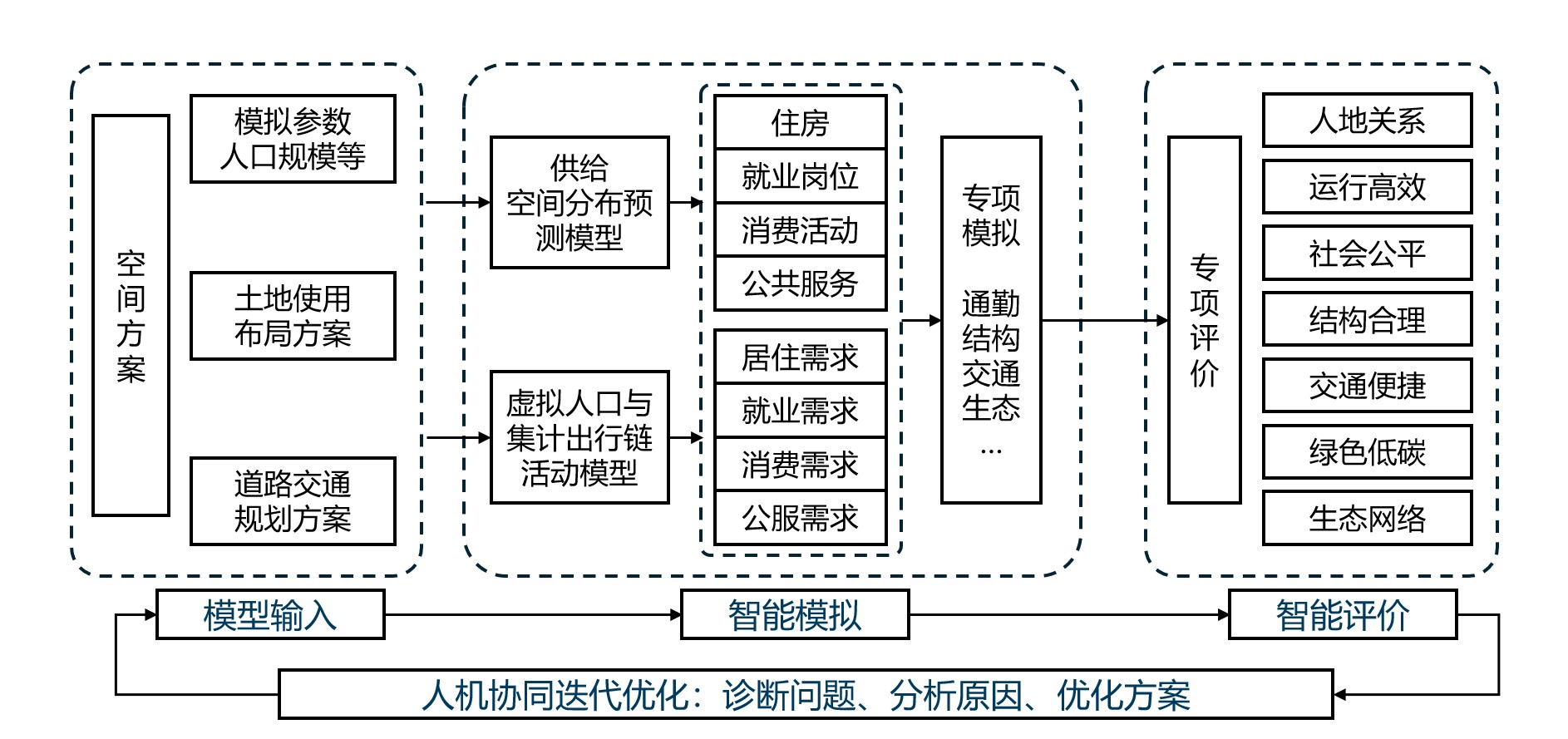
SimPlan以“智能模拟—智能评价—迭代优化”为基本工作流。 智能模拟模块集成多种城市活动模型和空间分析方法,分别模拟居住、就业、消费、公共服务等供给与需求的空间分布, 并进一步开展通勤OD、交通流量、中心体系、生态网络等专项模拟。

在模型构建上,系统强调可解释性、稳健性和可推广性。 供给侧主要采用回归模型模拟人口、就业、消费等空间供给;需求侧主要采用基于随机效用理论的活动地选择模型, 刻画居民在给定居住地或就业地条件下的目的地选择规律。

智能评价模块从人地匹配、运行高效、社会公平、空间结构、交通便捷、绿色低碳、生态安全七个维度组织指标体系。 系统能够自动生成数据大屏、分项评价图和指标详表,帮助规划师从总体表现回溯到局部问题, 从评价结果进一步定位用地结构、设施布局、交通组织和空间中心体系中的优化方向。

SimPlan follows a “smart simulation–smart evaluation–iterative optimization” workflow. It simulates the spatial supply and demand of housing, employment, consumption, and public services, and supports further analysis of commuting OD, traffic flows, urban centers, and ecological networks.

The system emphasizes interpretability and transferability, using regression models for supply-side estimation and discrete choice models for demand-side simulation.

Its evaluation module covers seven dimensions: human–land matching, efficiency, equity, spatial structure, transport accessibility, low-carbon performance, and ecological security. Automated dashboards, maps, and indicator tables help planners identify problems and guide spatial layout optimization.

SimPlan已经在空间绩效评价和空间布局优化实践中开展应用。在上海虹桥主城片区单元规划研究性案例中,研究通过模拟人口、就业、消费活动和交通流量,评价规划方案对通勤效率、消费出行、商业商务空间供需匹配和交通压力的潜在影响。结果表明,规划就业和商业中心有助于提升通勤和消费出行绩效,但也可能带来商务商业空间空置风险和局部交通压力。

在鄂尔多斯市中心城区案例中,SimPlan被用于总规空间布局方案的模拟评价和系统诊断,从用地调整、道路交通、中心体系、公共服务和生态安全等方面识别问题,并支持提出面向详细规划统筹的优化策略和管控指引。

此外,我们还针对上海单元规划的拼合方案开展了全面模拟,识别潜在的住房、商务楼宇、商业空间空置风险,分析出行距离、公服可达性等运行绩效,并基于总体规划的“战略引领”要求开展了系统评价。

这些应用表明,SimPlan能够把抽象的规划目标转化为可计算、可比较、可追溯的空间绩效指标,为总体规划完善、详细规划传导、多情景方案比选和规划实施评估提供技术支撑。进一步看,随着案例经验、模型参数和优化规则不断积累,SimPlan也将为智能方案生成与空间布局自动优化奠定方法基础。

SimPlan has been applied in spatial performance evaluation and layout optimization. In the Hongqiao case in Shanghai, it simulated population, employment, consumption activities, and traffic flows to assess potential impacts on commuting efficiency, consumption trips, commercial and office space matching, and traffic pressure.

In the Ordos case, SimPlan supported the simulation, evaluation, and diagnosis of the master plan, helping identify problems in land use, transport, center systems, public services, and ecological security, and informing optimization strategies for detailed planning.

SimPlan has also been used to evaluate integrated unit planning schemes in Shanghai, identifying potential vacancy risks in housing, office, and commercial spaces, while assessing travel distance, public service accessibility, and overall spatial performance.

These applications show that SimPlan can translate abstract planning goals into computable, comparable, and traceable indicators, supporting master plan refinement, detailed planning transmission, scenario comparison, and implementation evaluation. With accumulated cases, model parameters, and optimization rules, it can further support intelligent plan generation and automated spatial layout optimization.

Ref :
[1] 晏龙旭, 陈君南, 张尚武*, 王德, 李欣, 殷振轩, 窦寅. 面向空间绩效的规划模拟与评价:以上海市虹桥主城片区单元规划为例[J]. 城市规划学刊, 2023(05): 37-44.
[2] 晏龙旭, 张尚武*, 王颖, 王德, 胡杨, 牟聆汀. 面向空间布局优化的智能规划系统与应用[J]. 城市规划, 2024,48(10): 26-35.